Privacy for patients and clients is not a preference but a requirement. We frost consulting room windows, glass doors and partitions so that the space stays bright and the surfaces stay easy to clean, while nobody outside can see what is going on within.
In a clinic or salon, privacy is not a question of comfort. A patient waiting in the corridor must not be able to see what is happening in the consulting room. Someone who has come for a consultation does not want to be spotted by an acquaintance walking past on the pavement. This is one of the few sectors where the transparency of glass is a direct problem rather than an advantage, and where it has to be solved completely rather than partly.
The typical places we deal with are the window of a doctor's consulting room, a treatment room, a dental surgery, a consultation room and the glass doors between the waiting area and the working area. In most cases frosted film is the answer, since it completely blocks visibility while letting daylight through. Through it neither a face nor any detail can be made out, only diffused light.
There are also cases where more is needed. If the window sits at pavement level or directly opposite the windows of another building, and the privacy has to work in the evening with the lights on, we choose a fully opaque privacy film. That is an important nuance, because many people initially think of mirror film, which does not work in the evening.
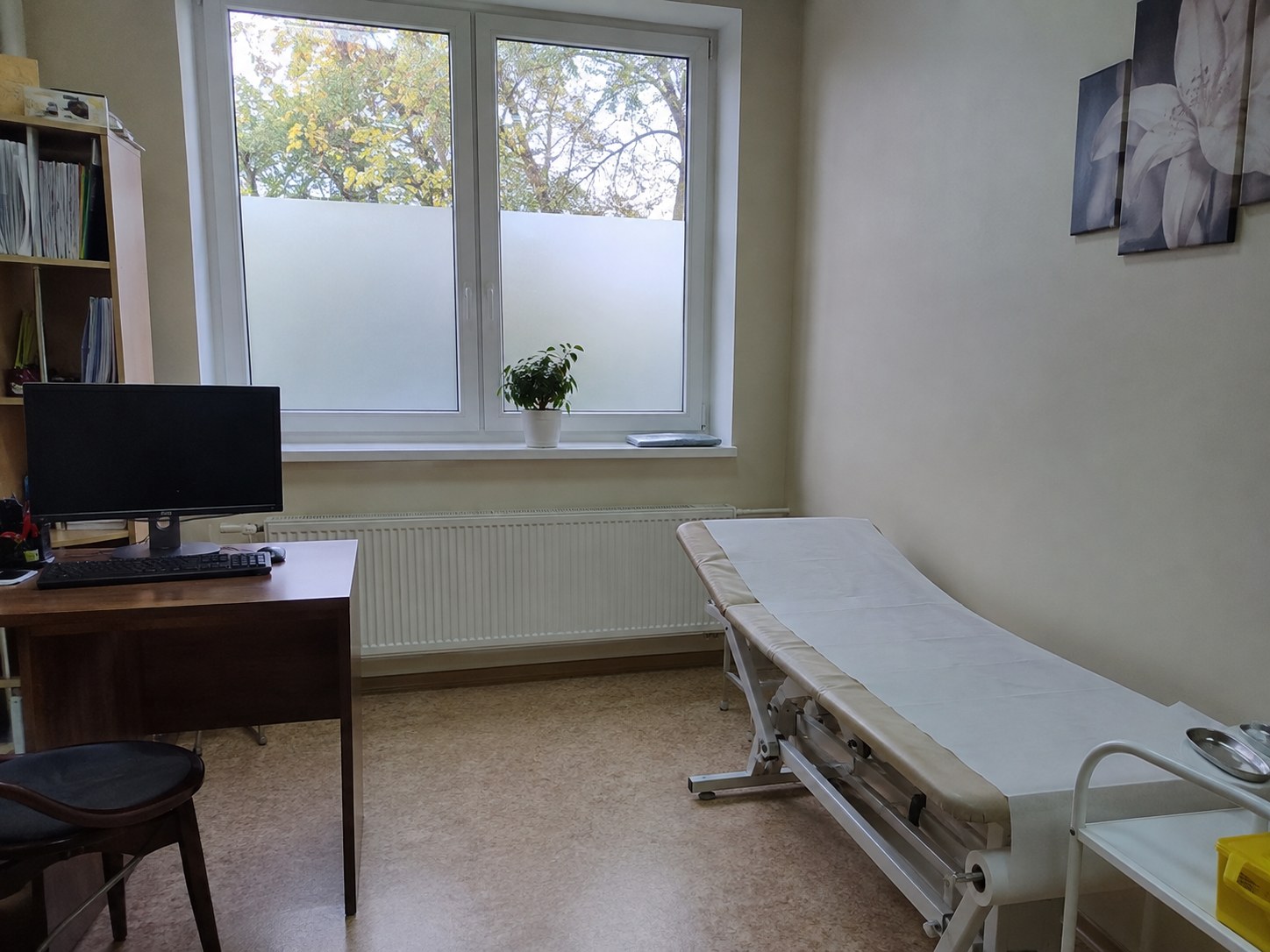
In a clinic or salon every room has a different requirement. The waiting area has to feel open, the consulting room closed, reception somewhere in between. That is why almost every site ends up as a combination of several films.
Here privacy is absolute. We frost the whole pane or, if the window is tall, its lower part up to a height of roughly two metres, leaving the top for light. If the room is on the ground floor or directly faces a neighbouring building, we choose an opaque privacy film that works in the evening as well.
The glass door to a consulting or treatment room is the place most often overlooked. We usually frost these across the whole pane. On doors, film is practical too: it can be wiped clean, it does not crease like a curtain and it is not damaged by the door being opened constantly.
For a glass partition between the waiting area and the working area, a frosted band at eye level is usually enough. A seated patient cannot be seen, the space loses no light, and the band also makes the glass visible so that nobody walks into it.
This zone must not look closed off - someone coming in has to understand where to go, and the space should feel open. At the same time, the receptionist's screen and paperwork are not meant for the people queuing. The solution is usually partial frosting directly behind the desk, or decorative film with a fine pattern.
In a salon the requirement is twofold and contradictory. The client does not want to be seen from the street with foils in their hair or halfway through a treatment, yet the room must not become dark, because colouring and cosmetology need good light. Frosted film resolves that - it diffuses the light rather than blocking it.
Rooms with south-facing windows are both hot and too bright in summer, and that affects the patient and the practitioner alike. Here we combine frosted film with solar control film, or choose a film that performs both functions.
In medical and beauty premises every surface is judged by how easy it is to keep clean, and in that respect film has the advantage over textile solutions. The surface of the film is smooth and continuous, without seams, folds or a porous structure. It is wiped down exactly like glass, with a damp cloth.
By comparison, fabric curtains and the slats of blinds collect dust, need washing or cleaning regularly, and always leave places between the slats where cleaning effectively never happens. In a clinic that is a genuine drawback, and it is precisely why so many premises switch from blinds to frosted film.
For cleaning we recommend a soft cloth and a mild product with no abrasive particles. Hard scraping, abrasive powders and stiff sponges damage the film, and that is the only real cause of wear indoors. For the first few days after installation the glass should not be washed at all, while the adhesive dries out fully.
If the glass surfaces also need protecting against breakage - low-set glass doors, say, or a partition in a corridor used by child visitors - frosted film can be combined with safety film, which holds the fragments together if the glass is broken.
Tell us which rooms need treating - consulting rooms, glass doors, partitions or the entrance area. We will prepare a quote and propose a working time that fits your schedule.
A day in a clinic or salon is divided into appointments, and every rescheduled visit is an unhappy client. So on these sites we plan the work one room at a time rather than tackling the whole practice at once. In practice that means one room is freed up for an hour and a half while the rest carry on as normal.
More often still, we work before the first appointment in the morning, after the last one in the evening, or at the weekend. In salons open late into the evening, the morning is usually the better slot. In clinics, where consultations start early, the reverse applies. We agree the specific schedule during the measuring visit, once we can see how long each room will take.
The work itself is quiet. There is no drilling, no strong-smelling solvents and no dust. All that is needed is clear access to the glass and the ability to cover the floor. Treatment chairs, equipment and desks usually only need pushing to one side.
In a clinic or salon, frosted glass reads as a mark of professionalism. It looks like etched glass - even, clean, deliberately chosen. Someone who sees a frosted door to a consulting room understands that their privacy is taken seriously here, and it does not have to be spelled out.
The opposite is a curtain over a glass door, or a sheet of paper taped to the window. That signals the same need but leaves the opposite impression. It is precisely why many practices come to us not because there is no privacy at all, but because the existing arrangement looks like a stopgap.
The frosting can be enhanced with a fine pattern, the company name or a band design, if you want the glass to become part of the interior as well. We discuss those options during the measuring visit. If your practice lies outside Riga - in Jūrmala, Mārupe, Ādaži or Ogre - take a look at our service area.
Frosted film makes it entirely impossible to see what is going on in the room - through it you can make out neither a face nor any detail, only diffused light. That is sufficient for a consulting room window, a treatment room and glass doors. What the film does not do is insulate against sound: if a conversation can be heard through the door or a thin partition, film will not solve that. It is worth establishing that distinction at the planning stage.
Yes. Frosted film is not dark - it diffuses light rather than blocking it, so daylight enters the room much as before, just without direct rays and without a view in from the street. That matters in salons, because colouring, manicures and cosmetology all need good light. If the room is narrow or north-facing, we choose a lighter degree of frosting or frost only part of the pane.
Yes, and in clinics those are among the most common places for it. The glass door to a consulting room, the partition between the waiting area and the treatment zone, the glass wall at reception - all of these surfaces can be frosted wholly or in part. On doors the whole pane is often frosted, while on partitions a band at eye level is used, which provides privacy and at the same time makes the glass visible so nobody walks into it.
The surface of the film is smooth and continuous, with no seams and no porous structure, so it can be wiped with a damp cloth exactly like glass. Unlike fabric curtains or the slats of blinds, it collects no dust and there are no places where dust stays out of reach. For cleaning we recommend a soft cloth and a mild product with no abrasive particles - hard scraping and abrasive cleaners damage the film.
In most cases, yes. In clinics and salons we work one room at a time and plan the job to fit your timetable - often before the first appointment in the morning, after the last one in the evening, or at the weekend. Treating a single consulting room window or a glass door usually takes very little time. The work is quiet, with no drilling and no strong-smelling solvents, so it does not disturb a consultation taking place next door.
Only partly, and it is important to know that in advance. One-way vision film works in the direction from the brighter side towards the darker one, so indoors, with artificial lighting on both sides, the effect is unreliable and in the evening it can reverse altogether. For reception areas and entrance glazing the safer solution is frosted film or a decorative band, which works regardless of the lighting.
Free measuring and a quote. We schedule the work so your appointments stay exactly as they are.
We have received your enquiry and will prepare a quote. We will call you on the phone number you provided.
