Blackout and privacy window film for apartments, houses and offices in Riga and within a 50 km radius. We shut out the view from outside while keeping the daylight in the room. From €25/m², film and labour included.
A lack of privacy is rarely a theoretical problem. It is the very concrete feeling of not being able to relax properly in your own home.
A ground-floor flat beside the pavement is the classic case. People walk past roughly half a metre from the glass, and in the evening, with the lights on inside, the kitchen and living room are on display like a shop window. Just as common is the second variant - windows looking straight at a neighbouring building or the stairwell of the block next door, where the two façades stand ten or fifteen metres apart and each side watches the other's daily life.
The third typical case is a bathroom or WC with a window. In Soviet-era designs these windows are often awkwardly placed, and there is no obscured glass. The fourth is houses whose plot borders a footpath, a cycle route or a car park, where people stop and quite naturally glance inside.
In all these cases there are usually three options: curtains, blinds or film. Curtains and blinds only deliver privacy while they are closed, and at that point the room is dark. In summer, when there is plenty of light and you want the windows open, that is a particularly unwelcome compromise. Blackout window film works differently - it is permanent and it does not shut out the daylight.
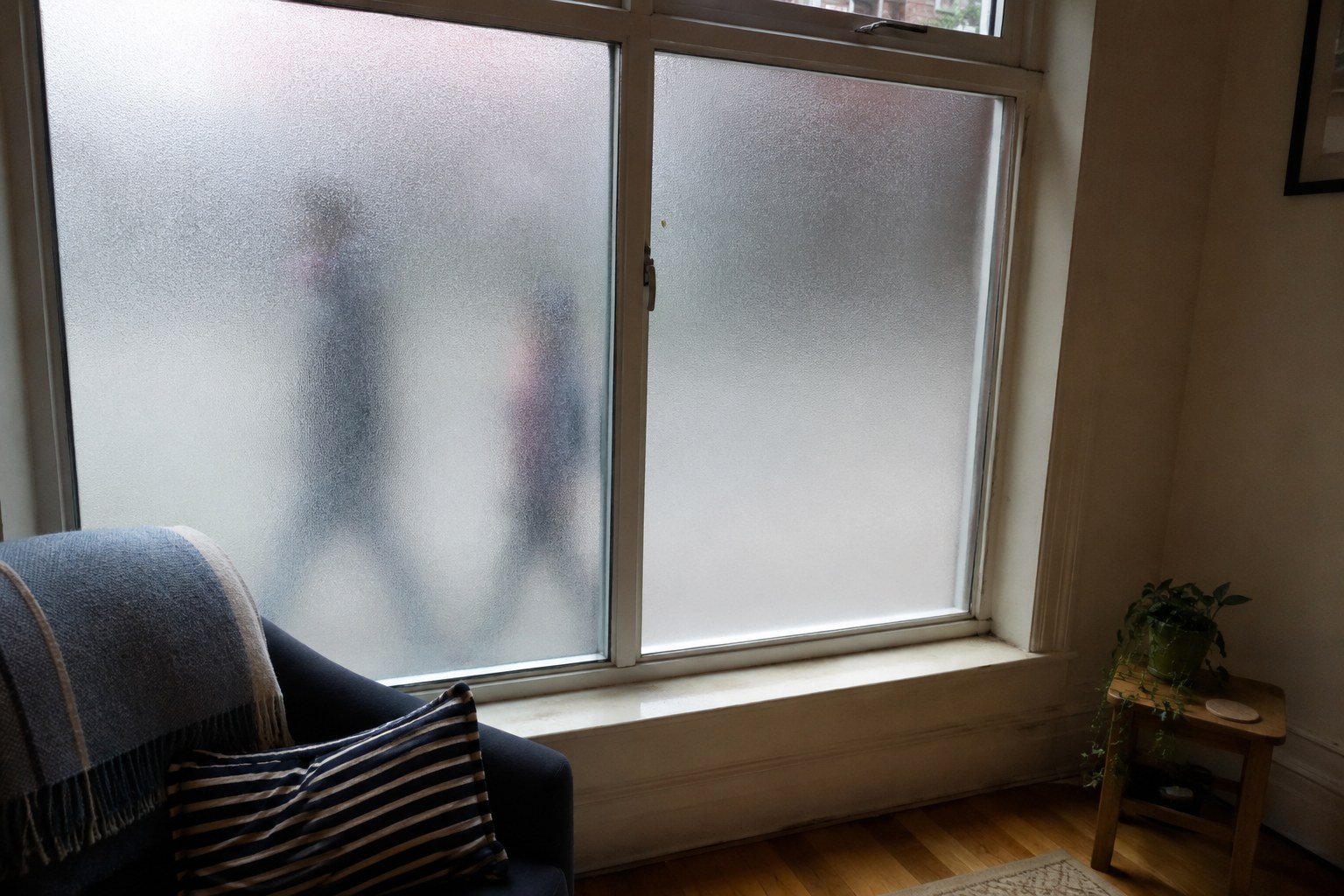
In everyday conversation "blackout film" covers several quite different materials. They work on different principles, and the right choice depends on the room, the time of day and how much daylight you want to keep.
Looks like factory-etched glass. Light passes through but the image is scattered, so only vague shadows are visible from outside. Its main advantage is that it performs identically day and night, regardless of which side is brighter. This is the safest solution for bathrooms, bedrooms and ground-floor flats.
Read more about this option in the frosted film section.
A dense, light-blocking material. Nothing shows through, and almost no light passes either. It is used where the view has to be shut out completely and daylight is not a consideration: plant rooms, sections of warehouses, server rooms, certain office walls. We rarely recommend it for living spaces, because the room becomes noticeably darker.
It is often more sensible to combine the two: an opaque band below, clear glass above.
By day the glass looks like a mirror from outside, while from inside the view is virtually unchanged. There is a bonus: it also reflects part of the solar heat, which suits south- and west-facing windows. The drawback is that the effect depends on the light - in the evening, with the lights on indoors, the mirror effect no longer works.
This is covered in detail on the mirror film page.
Works on the same difference-in-light principle as mirror film, but the emphasis is on the direction of view: from the brighter side you cannot see through the glass, from the darker side you can. It performs very well in offices, meeting rooms and street-level commercial glazing during the day.
How it works physically, and where it does not, is explained on the one-way vision film page.
This is the most important thing to grasp before choosing, and it is where disappointment most often arises. Mirror film and one-way vision film are not opaque in themselves. They exploit the difference in light between the two sides of the glass. While it is brighter outdoors than in, the street sees a reflection. Once darkness falls and the lights go on indoors, the situation reverses and the room becomes visible from outside.
Frosted and fully opaque films are not subject to that dependency. They alter the optical properties of the glass itself rather than exploiting a difference in lighting, so they perform identically at two in the afternoon and at eleven at night.
The practical conclusion is simple. If you need privacy in the evening and at night - a bedroom, a bathroom, a ground-floor kitchen - choose frosted or blackout film. If your problem is confined to daylight hours, in an office or a shop where nobody is on the premises in the evening, mirror film or one-way vision film is entirely sufficient and delivers a heat benefit besides.
You do not have to cover the whole window. Think about exactly where the line of sight comes from. On a ground floor, a passer-by's eye level is roughly a metre and a half above the pavement, so film on the lower part of the window is enough. The upper part stays clear: light comes in, you can still see the treetops and the sky from the sofa, and nothing at all is visible from the pavement.
The same principle works in houses where a window faces a footpath, and in bathrooms, where film up to about two-thirds of the window height is often sufficient. In offices, a band of film at eye level on a glass partition gives a meeting room privacy and doubles as a manifestation marking so that nobody walks into the glass.
Partial coverage is also cheaper, because you pay for the actual area of film. If a window measures 1.4 × 1.6 m and we cover only the bottom metre, the quote is for that section rather than the whole pane. During the measuring visit we usually suggest straight away where to draw the line so that the result looks deliberate rather than unfinished.
In the form, tell us which floor the windows are on, what they face, and whether you need privacy mainly by day or in the evenings too. That is enough for us to recommend a type of film.
We call and offer two or three suitable options with a price per square metre and an explanation of how they differ in practice.
We measure the glazing, look at the lighting conditions and discuss how high to set the edge of the film if you opt for partial coverage.
For a typical flat the work takes a few hours. We clean the glass thoroughly, cut the film to size and apply it from inside the room.
Blackout and privacy film costs from €25/m². Frosted and mirror films cost the same, while decorative films with a pattern start from €29/m². The price covers both the material and the labour - there is no separate installation charge to budget for.
We work in every district of Riga and across Greater Riga - from Purvciems and Imanta to Jūrmala, Mārupe, Ķekava and Ogre. You will find the full list of places we cover in the service area section. If your windows also have a heat problem, take a look at solar control film; and if the glass is somewhere breakage would pose a risk, safety film for glass is worth considering.
Describe where the windows are and when you need privacy - we will recommend the right film, get in touch and give you a quote.
The most suitable solution is frosted or blackout film. It diffuses light rather than blocking it - daylight still enters the room, but outlines can no longer be made out from outside. Unlike curtains and blinds, film works around the clock and never needs opening or closing. If daylight is especially important, we choose a lighter degree of frosting or cover only the lower part of the window.
Frosted and fully opaque films work at night too, because they physically scatter the image regardless of the lighting. Mirror film and one-way vision film behave the opposite way after dark - once it is brighter indoors than outside, the effect reverses and what happens inside becomes visible from the street. That is why we normally recommend frosted or blackout film for bedrooms and bathrooms.
Blackout and privacy film starts from €25/m². The price includes both the film and the installation. Prices are excl. VAT and the minimum order is €75. The final sum is affected by the size and number of panes, the access to the windows and the amount of offcut waste, so we give an exact quote after free measuring on site.
Yes, and in practice it is one of the most common solutions. On ground floors a passer-by's line of sight falls on the lower and middle sections of the window, so film up to roughly a metre and a half from the floor is enough. The top of the window stays clear, the room keeps its light and its view of the sky, and nothing is visible from street level. The same principle is used on office partitions, where a band of film is applied at eye height.
Frosted film diffuses light without blocking it entirely, so most houseplants on a windowsill are perfectly happy. More care is needed with fully opaque, dense films and with very dark mirror films, which reduce light levels noticeably. If you have light-hungry plants on the sill, mention it in your enquiry - we will choose a lighter option or leave part of the glass clear.
Yes. The film sits on the surface of the glass rather than being built into it, so it can be taken off. Removing old film is a separate service from €8/m². Newer film usually comes off relatively easily, whereas film that has baked in the sun for years tends to tear into pieces and the adhesive has to be cleaned off separately, which takes longer.
Describe your situation - we will recommend a solution, get in touch and give you a quote. Free and with no obligation.
We have received your enquiry and will prepare a quote. We will call you on the phone number you provided.
