A full comparison of every type of window film for building glass: the problem each one solves, how much light it lets through, whether it gives privacy by day and by night, what it costs and which rooms it suits. Plus an honest look at the trade-offs, because every film has them.
Window films cannot be ranked from worst to best. They solve different problems, and a film that is perfect for one customer will be a mistake in someone else's home. So the question “which window film is best” is better put like this: which one solves my particular problem with the fewest side effects?
Side effects are unavoidable, and that is the single most important thing this page is trying to say. Every window film is a compromise between four things: daylight, heat, privacy and the appearance of the glass. You cannot get more privacy or more heat reflection without giving up some light. You cannot get a mirror effect without changing how the building looks from the street. What can change is how high a price you pay for the particular benefit.
Below you'll find, first, a comparison table covering all the types; then a decision flow organised by problem; and finally a section on the trade-offs that usually go unmentioned. Prices for every type are collected on the prices page, and the full list of services is in the services section.
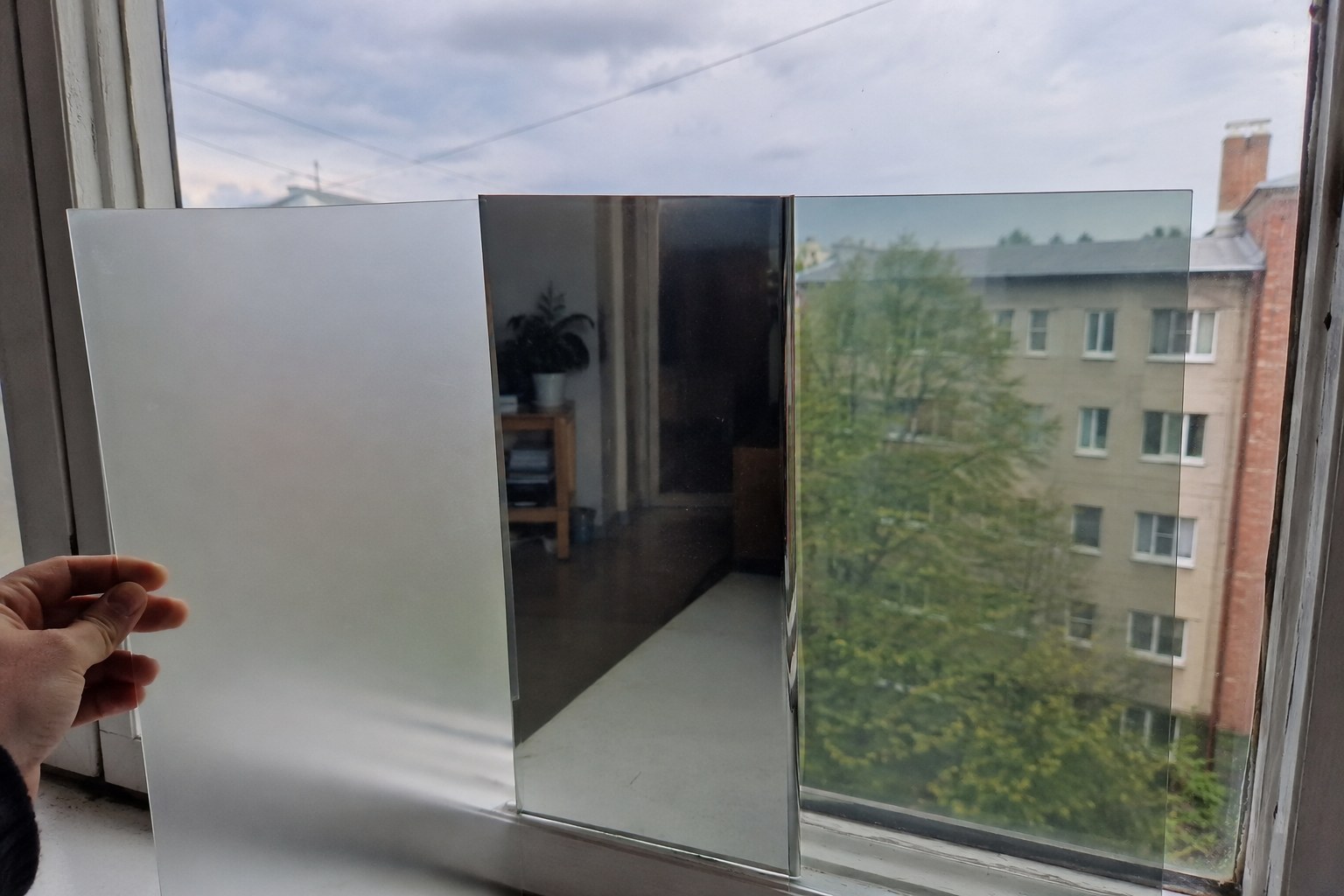
The table can be read in two directions: from the problem to the film, if you know what's bothering you, or from the film to its consequences, if you have already picked something and want to know what to expect. The names link through to the relevant service page.
| Type of film | Problem it solves | Effect on light | Privacy by day | Privacy at night | Price level | Suited to |
|---|---|---|---|---|---|---|
| Solar control film | Heat and glare from the sun | From almost invisible to distinctly dark, as you choose | Partial, if a darker grade is chosen | None | from €25/m² | South- and west-facing rooms, roof windows, glazed terraces |
| Heat rejection film | The room overheats and the air conditioning can't cope | Medium to low light transmission | Partial | None | from €25/m² | Attic conversions, loft rooms, offices with glass façades |
| Mirror film | Being overlooked in daytime, plus heat | Noticeably reduces light; the view out is preserved | Yes, strong | No - the effect reverses | from €25/m² | Ground-floor flats, offices, rooms facing neighbours' windows |
| One-way vision film | You need to see out without being seen | Reduces light; stays see-through from inside | Yes, from the brighter side | No, if the lights are on inside | from €25/m² | Meeting rooms, salon treatment rooms, reception desks |
| Frosted film | You need privacy but want to keep the light | Diffuses light: the room stays bright, the view goes | Yes, complete | Yes, unchanged | from €25/m² | Bathrooms, consulting rooms, partitions, door glass |
| Blackout privacy film | The view in has to be shut off entirely | Depends on the grade, from light to completely solid | Yes, complete | Yes, unchanged | from €25/m² | Ground floors, washrooms, warehouses, plant rooms |
| UV protection film | Furniture, parquet, fabrics and stock are fading | Can be almost clear; light barely changes | None | None | from €25/m² | Shop windows, living rooms with parquet, galleries |
| Thermal insulation film | Cold in winter, hot in summer, and new windows aren't an option | Medium light transmission | Partial | None | from €25/m² | Older buildings, large glazed areas, rooms with a poor heat balance |
| Safety film, standard | The glass could break and the shards pose a risk | Clear; light is practically unchanged | None | None | from €25/m² | Door glass, low panes, offices and homes with children |
| Safety film, reinforced | Higher requirements for resisting glass being smashed | Clear | None | None | from €35/m² (8 mil), from €41/m² (12 mil) | Shop windows, entrance areas, ground-floor commercial units |
| Decorative film | The glass looks blank and needs design or zoning | Depends on how dense the pattern is | Partial or complete, depending on the pattern | The same as by day | from €29/m² | Office partitions, shop windows, entrance doors, private homes |
| Adhesive window film | A general term for self-adhesive films | Depends on the specific type | Depends on the type | Depends on the type | from €25/m² | The term many conversations about window film start with |
All prices are excl. VAT and include both the film and the labour. Minimum order €75. The effect on light varies within each type, because the same type of film comes in different levels of lightness.
The simplest route to the right film is to start with what exactly is bothering you and work through it step by step. Here are the six most common starting points.
The next question: how important is it to keep the room bright?
Yes, light matters. Choose a lighter solar control film. The effect on heat will be more moderate, but the room will stay bright.
No, staying cool comes first. Then a darker solar film, heat rejection film or mirror film works well, the last of which also gives daytime privacy.
The next question: do you need to keep the view out?
Yes, the view matters. Then the choice is mirror film or one-way vision film. Remember that in the evening, with the lights on, the effect reverses.
No, the view isn't needed. Then frosted film or blackout privacy film. Both work the same way around the clock.
Here the problem is ultraviolet radiation, not heat or light. It passes through glass even on a cloudy day.
The solution is UV protection film, and its advantage is that it can be almost completely clear. The look of the room barely changes. In shop windows that matters especially, because the goods have to be visible but must not fade. More detail: solutions for shops and storefronts.
The next question: how serious is the risk?
Everyday safety. Door glass, low panes, homes with children. Standard safety film from €25/m² is enough.
Commercial premises with shop windows. Then reinforced film from €35/m², or the thickest grade from €41/m². This choice changes the total significantly, so we talk it through before the work.
This is a design task rather than a physical one. On office glass partitions it is often a safety matter too, because people walk into blank glass.
The options: decorative film with a pattern or bands, glass partition treatments, a logo on the glass or storefront graphics. These jobs are priced individually, because the price depends on the artwork.
If the film has yellowed, cracked or gone bubbly, new film is never applied over the top. The old film has to come off first, along with any adhesive residue.
That is a separate job - film removal from €8/m² - which can be combined with applying the new film in one visit. After removal the glass is prepared so that the new film can go on straight away.
Every film gives you something and takes something away. These are the most common cases where a customer ends up disappointed, and almost always the reason is that nobody warned them about the trade-off in advance.
The more solar heat a film reflects, the less light it usually lets through. On a north-facing side, or in a room that is already dark, that can be unpleasant: the effect is welcome in summer, but by November the room feels gloomy. In places like that it is often better to choose a lighter film and accept a more moderate effect on heat.
This is the most common disappointment. Mirror film and one-way vision film work on the difference in light levels between the two sides. In the evening, with the lights on inside and darkness outside, the effect reverses and the room is clearly visible from the street. If you need privacy in the evenings as well, you need frosted film, or film together with curtains.
Frosted film gives complete privacy around the clock, but the view out disappears entirely. In a bathroom that is no loss. In a living room with a fine view it is a considerable one, and people often only realise it after installation. That is why we recommend frosting only the panes, or the part of the window, where privacy is genuinely needed.
Mirror and darker films change the appearance of the façade. In an apartment block where the other windows have no film, the difference is noticeable. In some buildings it is also a matter of approval from the building manager. That is worth establishing before the work, not after it.
If the windows are draughty, no longer close properly or are simply worn out, film will not fix that. Likewise film does not prevent condensation, because the cause of that is humidity and ventilation, not the glass. In those cases it is more honest to say so straight away than to sell a solution that won't work.
Not every film suits every type of glass. Dark, heat-absorbing films increase the thermal load on certain glazing units. So the type of film has to be matched to the glass that is actually there, and that is one reason we look at the glass during measuring rather than relying on dimensions alone.
Most customers come to us not with the name of a film but with a description of a situation. For example, that the south-west facing room is unbearable in the afternoon, or that on the ground floor passers-by can see into the kitchen. That is quite enough: the rest is our job.
During the measuring visit we look at which way the windows face, what the glass is, how bright the room is without film, and whether there are plants on the sills. All of that changes the recommendation. Two identically sized windows in the same house may call for two different films if one faces south and the other faces a courtyard on the north side.
You'll find recommendations tailored to the type of property on our pages for homes and apartments, offices and clinics and salons. Answers to the most common questions are in the FAQ section, and you can check our coverage on the service area page.
Describe the situation and we'll recommend a specific type of film, along with an explanation of what you gain and what you give up. We'll go through the quote with you by phone.
There is no single right answer, because different films solve different problems. The best one is the one that matches your task. For heat, that means solar control or heat rejection film; for privacy, frosted, blackout or mirror film; where there is a risk of the glass breaking, safety film. If you try to solve every problem with one film, the result is usually a compromise that solves none of them well.
To an extent, yes. Mirror film and darker solar control films both reflect part of the heat and make it harder to see in during the day. But there are two limitations to be aware of. First, privacy of this kind only works in daylight hours. Second, the more a film does at once, the less daylight is left in the room. If you need complete privacy around the clock, the better approach is to choose frosted film and deal with the heat question separately.
They solve the same problem in completely different ways. Frosted film diffuses light: the room stays bright, but the view disappears in both directions, and it works the same by day and by night. Mirror film reflects: from outside you see a mirror, from inside the view out is preserved, but the effect only works while it is brighter outside than in. The choice essentially comes down to one question: does the view out matter to you?
Against heat and glare, usually yes: the more light a film lets through, the less heat it reflects. But that does not apply to every film. UV protection film can be almost completely clear and still do its job, and safety film barely affects light at all, because its role is mechanical. So the relationship between lightness and effect has to be judged separately for each type of film.
Yes, and it is often the right solution. A typical example is an apartment where solar control film goes on the south-facing room, frosted film in the bathroom and safety film on the balcony door glass. Each room addresses its own task. The only thing worth keeping in mind is the external appearance: if the windows are on the same façade and clearly visible from the street, it is worth choosing films that look similar from outside.
Start with the problem, not with the name of a film. Write down what exactly bothers you, at what time of day it happens, which way the windows face and whether the view out matters to you. Those four things are enough to narrow the choice down to one or two options. If you are still unsure, describe the situation in the form: we'll suggest an option and explain what you gain and what you give up.
At the free measuring visit we look at the glass on site and recommend the film that suits your particular room. Riga and within a 50 km radius.
We have received your enquiry and will prepare a quote. We will call you on the phone number you provided.
