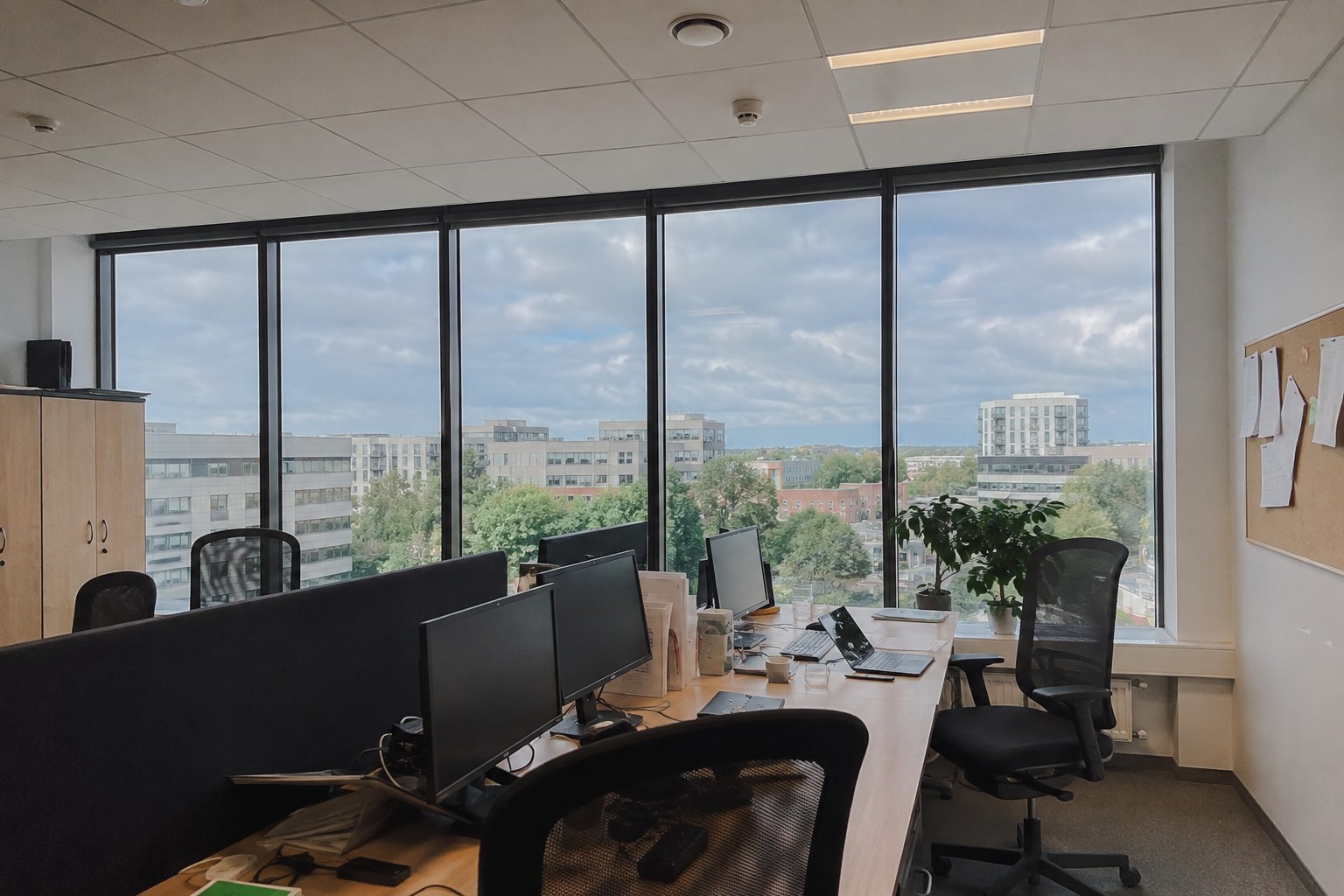
Glare on monitors, overheating beside a glass façade, meeting rooms where everything can be seen and heard. We work outside office hours, so the office is running as normal in the morning.
In an office it shows itself very concretely. Desks by the window become unusable at certain hours of the day, because all that can be seen on the monitor is a reflection. People start turning their desks round, angling their screens, closing the blinds and switching on the ceiling lights at lunchtime. In the end an office designed to be bright is used with the blinds shut, and the very part of the floor plate that costs the most is the part used worst.
Glare comes from too great a contrast in light between the screen and the window behind it. Solar control film reduces the light coming through evenly across the whole pane, so the contrast levels out and what is on the screen stays readable. Unlike blinds, film creates no striped shadows and does not block the view - and nobody forgets to open it every morning.
Where glare is particularly severe we use a film with a light mirror effect on the outside. That answers two questions at once: it cuts the light at the desks and makes the office less visible from the street during the day. How mirror film behaves in the evening has to be discussed separately, because the direction then reverses.
Office enquiries differ from domestic ones in that the decision is taken by one person while the problem is felt by many. Below are the briefs that come up most often.
In modern office buildings with extensive glazing, summer heat builds up faster than the ventilation can carry it away. The air conditioning in a space like that runs almost continuously, and even so it is too hot on one side of a desk and too cold for the colleague next to you. Film reduces heat gain at the glass itself, so the temperature evens out and the cooling system has less work to do.
A glazed meeting room is a good idea right up until the moment salaries are being discussed in it or client data is on the screen. A frosted band at eye level, usually from 90 to 160 cm off the floor, solves that without closing the room off. Seated people cannot be seen from the corridor, but the glass above and below the band stays clear.
In individual offices with a glass wall onto the open-plan area, the need is the reverse: the occupant has to see the team, but the screen and the documents on the desk must not be readable from outside. Here we use frosted film partially, only on the section of glass behind the desk.
A clear glass partition is hard to see, and people walk into it. That is not a theoretical risk - it is one of the most common minor injuries in offices. A band, a dot pattern or the company logo on the glass makes the partition visible and doubles as a design element.
In open-plan space the problem is usually light and heat across a large area, so the solution is uniform across the whole façade. In a cellular office every room has its own requirement, and there it more often works out as a combination of two or three types of film on one site. We measure and quote for both arrangements separately.
Ground-floor offices and entrance areas with large expanses of glass often have safety film added, which holds the fragments together if the glass is broken. Standard-thickness film starts from €25/m², reinforced from €35/m².
In an office the main constraint is not technical but organisational. Nobody wants half a department sitting without a desk for half a day. That is why on almost every office job we work outside office hours: in the evening after the working day ends, early in the morning before nine, or at the weekend. Access, security arrangements and a responsible contact person are agreed in advance, during the measuring visit.
On larger sites we split the work into stages. In practice that means one floor or one group of rooms at a time, with a separate schedule for each stage. This lets a company move staff to another zone for a single evening shift rather than arranging remote working for the whole building. We can prepare a separate quotation for each stage, which makes budget approval easier.
Before the film goes on, desks only need clearing enough to reach the glass - usually that means pulling the desk away from the window and taking personal belongings off the sill. We do not touch the IT equipment, but we recommend that staff move their own monitors and documents. We cover the floor and the nearest surfaces.
The work creates no dust and uses no strong-smelling solvents, so the space can be used first thing the next morning. All we ask is that the treated glass is not washed for a few days, while the adhesive dries out fully.
Give us the approximate glazed area, the number of floors and the problem. We will prepare a quote with the price per square metre and a total, suitable for internal approval.
Most Riga offices operate in leased premises, and that changes the whole calculation. Investing in replacement solar-control glazing in premises whose lease expires in three years makes sense for very few companies. On top of that, replacing a glazing unit is construction work: it has to be agreed with the owner, planned as a project and carried out with access restrictions across a whole section of the building's façade.
Film touches neither the glass, nor the frame, nor the structure. It is applied to the existing glass surface and, if need be, can be removed, leaving the glass as it was. For a tenant that means the space can be adapted to suit without taking on a long-term commitment to the building. We do nonetheless recommend checking the section of the lease dealing with alterations and notifying the landlord in writing - usually a formality, but better dealt with before than after.
There is a second argument as well. Film goes on in a single evening, not as a project spanning several weeks. If the office is already overheating in June, the difference between a solution that works next week and one that works next season matters in practice.
In offices film is rarely just a technical solution. A façade of uniform tone looks orderly from outside - quite unlike the situation where every office has covered itself with its own blinds at different heights. Inside, decorative films on the partitions allow you to zone the space without any further building work: one room gets a patterned band, another full frosting, a third the company logo by the entrance.
Logos and printed graphics on glass are quoted individually, since the price depends on the intricacy of the artwork, the size, and whether the design is cut from film or printed. We usually combine this with the rest of the work on site in a single visit.
If the office lies outside the Riga city boundary - in Mārupe, Ķekava, Ādaži or Ogre - it still falls within our working area. The full list is on the service area page. If the glass also has to protect equipment and documents from fading, UV protection film is useful, as it barely changes the appearance of the glass.
Yes, in offices that is almost standard practice. We work in the evening after the working day ends, early in the morning or at the weekend - whichever suits you best. We agree access, security arrangements and a responsible contact person in advance. On Monday morning staff come back to a clean workstation, and not a single meeting has had to be rescheduled.
Film is not regarded as a structural alteration, because the glass, the frame and the structure are left untouched. It is applied to the existing glass and, if need be, can be removed, leaving the glass as it was. That is one of the main reasons film works out better for tenants than replacing the glazing. Even so, we recommend checking the section of your lease dealing with alterations to the premises and notifying the landlord in writing.
Air conditioning cools the air but does nothing to stop heat coming in through the glass. On a hot day it runs continuously and still cannot cope with rooms facing south or west. Solar control film reduces the amount of heat that gets into the room in the first place, so the air conditioning has less work to do and the temperature evens out across the space. In practice, what usually disappears is the situation where one part of the office is cold and the other is hot.
The most common solution is a frosted band at eye level - usually somewhere between 90 and 160 cm from the floor. Seated participants cannot be seen from the corridor, and from inside the room nobody sees people walking past, but the glass above and below the band stays clear, so the room loses no light and does not feel closed in. Where full privacy is needed, we frost the whole pane.
A completely clear glass partition in an office is hard to see, particularly when there is a bright corridor or an open-plan area behind it. People walking into them is a common occurrence and occasionally ends in injury. A frosted band, a dot pattern or the company logo on the glass makes the partition visible while keeping the open feel of the space. That same band is frequently used as a design element too.
Yes. We work with businesses and issue an invoice with payment terms. The quote sets out the price per square metre, the total area and the total sum - usually everything needed for internal approval. Prices are excl. VAT. On larger sites the work can be split into stages with a separate quotation for each floor or group of rooms.
Free measuring, a price per m² and a total. We schedule the work outside your business hours.
We have received your enquiry and will prepare a quote. We will call you on the phone number you provided.
