Faded stock in the window, an overheated shop floor, unprotected large-format glass right on the street. Storefront film solves all three while keeping the goods on view. We work before opening or after closing.
In a shop, UV radiation is not an abstract problem. Clothing displayed in the window on the sunny side is a different shade after one summer from the same item in the stockroom. Cosmetics boxes and book covers fade so much that the item becomes unsellable even though everything inside is perfect. In food shops it is the packaging design that suffers; in gift shops, fabrics, paper goods and coloured labels.
In practice that means one of two things: the item is marked down or written off. If the window holds a couple of hundred euros' worth of stock at any one time and the display changes monthly, the annual loss easily exceeds the cost of storefront film. Shop owners generally do that sum for themselves as soon as the problem is named.
The answer is UV protection film, which is very nearly clear. Seen from the street the window looks exactly as it did, and the goods are just as visible. If heat on the shop floor also has to be dealt with, we use solar control film and pick the lightest option that still solves the heat problem.
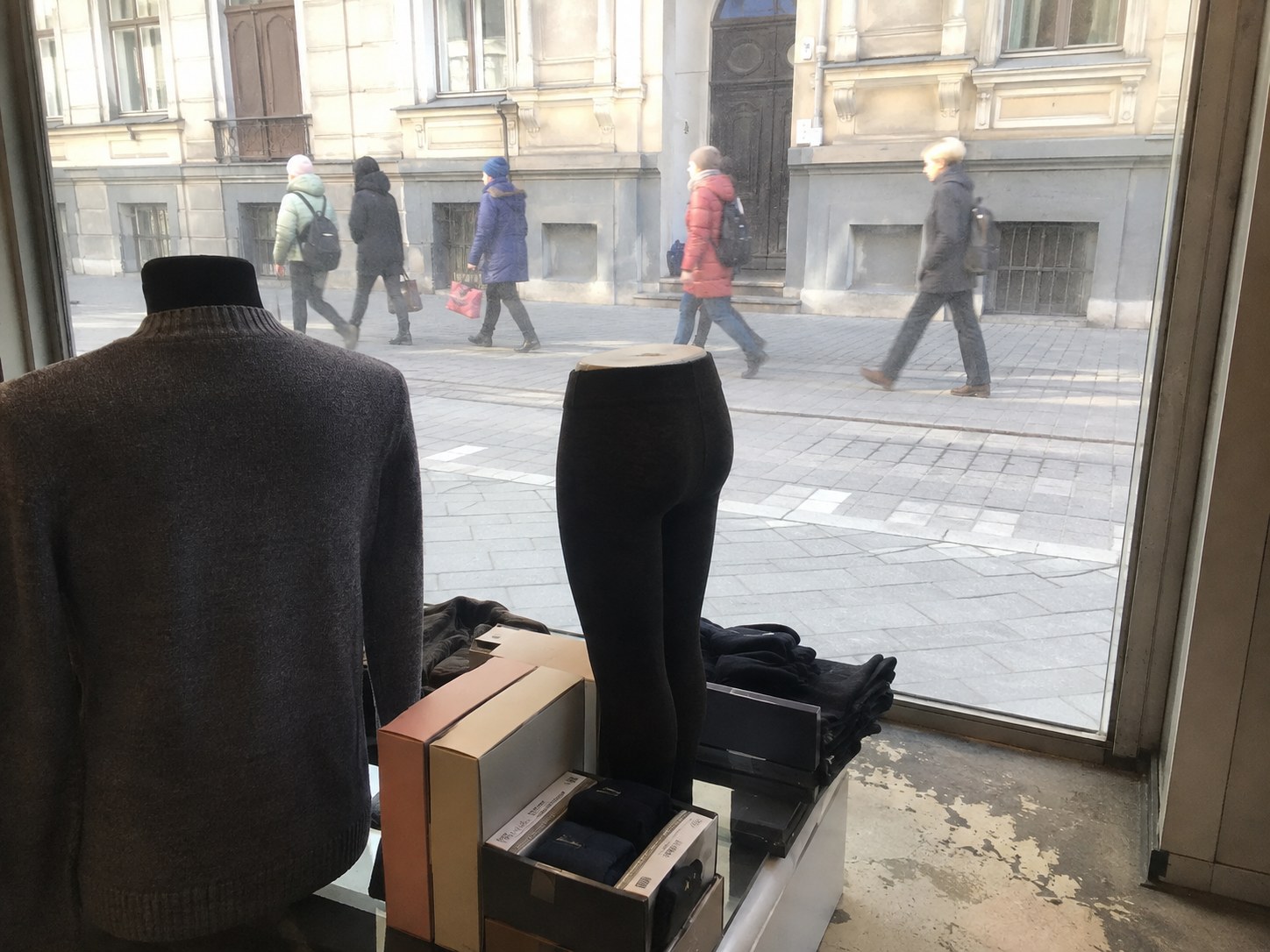
In a shop the glass performs several roles at once: it is a display window, an advertising surface, a wall and a security boundary. Each of those roles has its own type of film.
A large south-facing shop window heats the whole front of the floor in summer. That affects customers, but it affects the staff standing there for a full shift far more. In food and cosmetics shops the warmth by the window also affects the quality of the goods themselves. Solar control film reduces heat gain at the glass itself.
Shop window glass is large, thin and right on the street. Safety film holds the fragments together, so after a blow the glass stays in the frame instead of collapsing onto the pavement. In a break-in that takes more time and more noise. Standard film from €25/m², reinforced from €35/m², the thickest from €41/m².
Not everything behind the glass is meant to be shown. Stockroom doors, the backs of shelving units, the till, cabling and technical areas are often right by the window. Frosted film on just that section of glass tidies up the view from the street without obscuring the rest of the window.
A logo, text, opening hours or icons cut from film on the entrance door look considerably tidier than a sheet of paper taped up. These elements can be replaced when the season or the offer changes. Logos and printed graphics are quoted individually.
Window graphics campaigns tend to change more often than the film itself. In such cases we plan the work so that the underlying protective film stays put for the long term while the decorative elements over it are changed separately, without damaging the layer beneath.
On shop windows film wears out faster than indoors, because it is in direct sun all day. Cracked film, or film that has turned purple, does a shop more harm than no film at all. Removal from €8/m², usually in the same visit as applying the new film.
For a shop every hour closed is lost turnover, and that is the main thing setting these sites apart from all the others. So we treat shop windows outside trading hours - early in the morning before opening, in the evening after closing, or at night. In shopping centres we agree the access times, the security arrangements and the loading point with the management in advance, during the measuring visit.
The window display is largely left undisturbed. We need access to the glass from inside, roughly a metre's width, so mannequins, stands and stock are moved aside for the duration of the work and put back afterwards. If the display is elaborate and it is a member of the shop's staff who rearranges it, we agree that in good time, so that nobody starts doing it spontaneously halfway through the job.
Most shop windows are finished in a single shift. For larger sites with a long street frontage or several floors we split the work into sections, so that no day begins with a half-finished window. When we have finished we clear away the offcuts and leave the glass clean.
The only stipulation afterwards is that the treated glass should not be washed for a few days, while the adhesive dries out fully. During this period slight hazy patches may be visible against the light; they disappear of their own accord and are not a defect.
Give us the approximate area of the window and the main problem - fading stock, heat, security or design. We will get in touch by phone.
The window is the first thing people see, and often the only thing they use to decide whether to come in. That makes the condition of the glass every bit as important as the stock itself. Worn, bubbled or purple-tinged old film does a window more harm than bare glass would. It is the passer-by who notices it first, not the owner, who looks straight ahead on the way in rather than at the glass.
Decorative films let you give a window character without any refurbishment. Frosted bands at a set height, a dotted pattern, the shop name cut from film or full graphics on a side pane - all of it goes onto the existing glass and can be changed as required. On a shopping street where there are five other windows next door, it is the simplest way to stand out without spending the budget on rebuilding the shopfront.
If the shop is outside Riga - in Jūrmala, Ogre, Salaspils or Mārupe - it still falls within our working area. The full list is on the service area page.
Not every retail space wants its interior fully on view. Salons where consultations take place, offices with a retail area and shops with a high-value stock zone often want the opposite - less visible from the street than the street is from inside. This is where mirror film comes in, producing a mirror effect from the street side during the day.
The limitation matters. The mirror effect works in the direction from the brighter side to the darker one. During the day it is brighter outside, so all that is visible from the street is a reflection. In the evening, when the shop lights are on, the ratio reverses and the interior becomes visible. For a shop trading into the evening that means mirror film is not a privacy solution - frosted film is the better fit then.
We talk this difference through before the work, because it is the most common misunderstanding in shopfront projects. Far better to settle it during the measuring visit than on the first evening after the film goes on.
No, and that is precisely why it is the most common choice for shop windows. UV protection film is very nearly clear - seen from the street the appearance hardly changes at all, and the goods in the window remain just as visible. What changes is what the glass lets through. If heat also has to be reduced, we use a lightly tinted solar control film, choosing the lightest option that still solves the heat problem.
Yes, in retail that is the norm. We work early in the morning before opening, in the evening after closing, or at night if a shopping centre's regime requires it. In shopping centres we agree access and the working window with the management in advance. Shop windows are usually finished in a single shift, so trading carries on as normal the next day.
Fabrics and clothing fade fastest, especially coloured and dark garments. Next come printed materials and packaging - book covers, cosmetics boxes, product labels, where faded design makes an item unsellable even though the product inside is perfect. Cosmetics and leather goods suffer too. In practice this means writing stock off or marking it down, which is why storefront film often pays for itself sooner than you would think.
Safety film is not armoured glass and is not invulnerable. It holds the fragments of glass together, so after a blow the pane does not collapse onto the pavement but stays in the frame. In a break-in that takes more time and more noise, and that is often the decisive factor. Just as importantly, a window broken by accident does not scatter a mass of large glass pieces across the pavement. Standard-thickness film starts from €25/m², reinforced from €35/m² and the thickest from €41/m².
Yes. A logo, text, opening hours, frosted bands or full printed graphics can all be cut from film and applied to the glass. A frequently used option is a frosted band along the bottom of the window, which conceals stockroom shelving or cabling while leaving the upper part for the goods. We quote for logos and printed graphics individually, because the price depends on the size, the complexity and whether the design is cut or printed.
We take it off. Removing old film is a separate service from €8/m². On shop windows the film is usually older and more sun-baked than it would be indoors, so it tends to tear into small pieces and the adhesive has to be removed separately - which takes longer. Once it is off we prepare the glass so that new film can go straight on, and we normally carry out both jobs in a single visit.
Free measuring at a time that suits you. We schedule the work outside trading hours.
We have received your enquiry and will prepare a quote. We will call you on the phone number you provided.
