UV protection for windows in homes, shops and galleries in Riga and within a 50 km radius. Helps protect parquet, furniture, fabrics and stock from gradual colour loss. A clear film that leaves the look of the window virtually unchanged. From €25/m².
Unlike heat or glare, the effects of ultraviolet radiation are not felt at the time. They become visible years later, and by then it is too late.
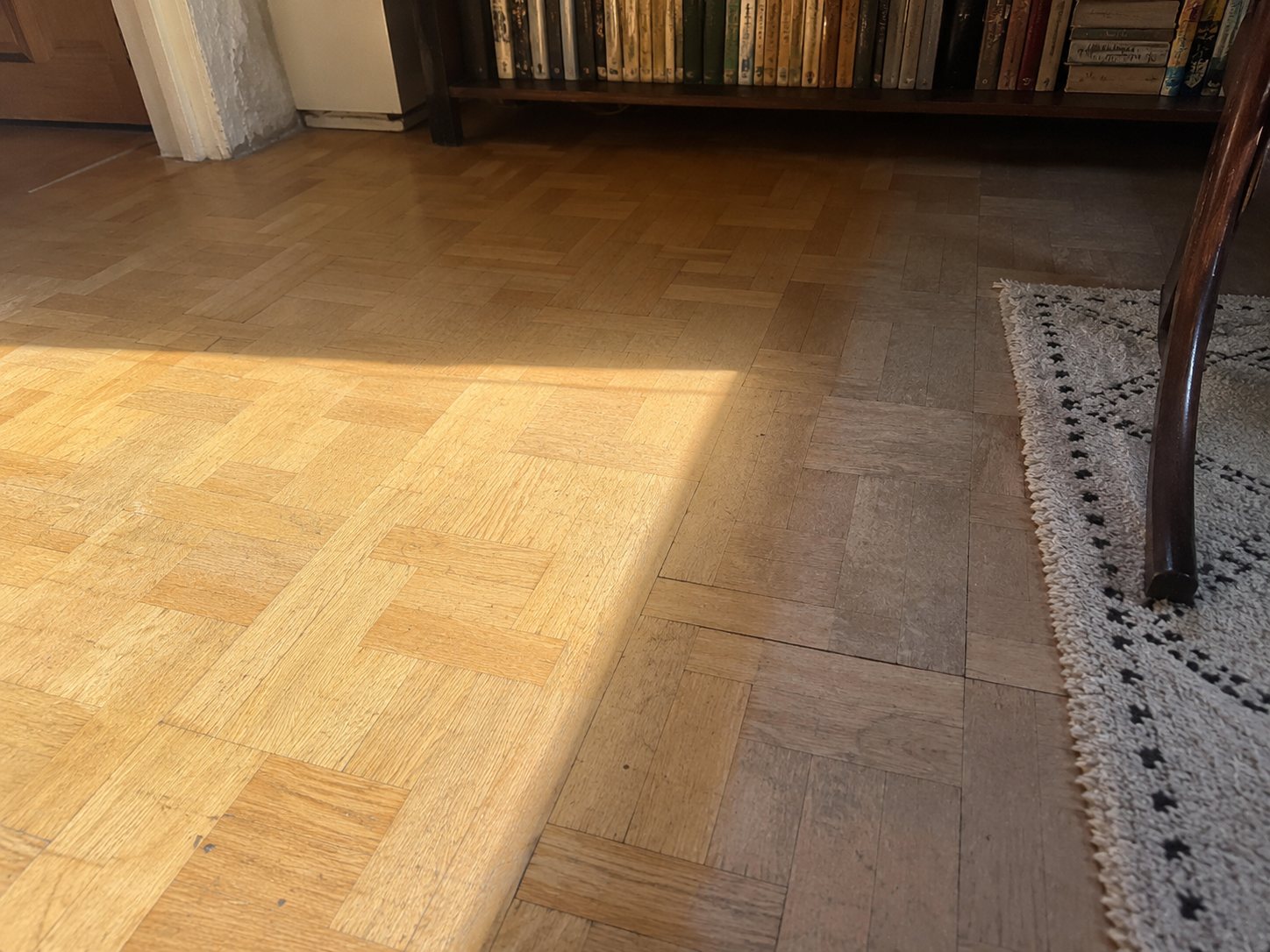
The moment people typically notice is when the furniture gets rearranged. Under the sofa or the rug, the parquet is noticeably darker than the floor around it. The same shows in curtains whose sun-facing edge is lighter than the other side, and in the flank of a sofa that has stood facing a south window for several years.
Ultraviolet radiation breaks down the pigments in materials. Oak parquet turns yellowish or lighter, leather furniture loses its depth, fabric upholstery goes dull, and the spines of the books on the shelf by the window are the first to fade. In shops it affects whatever is on display in the window: clothing, packaging, cosmetics, printed material. In galleries and salons it applies to artworks and display samples.
The crucial thing to grasp is that the process is cumulative and irreversible. Every sunny day adds to the last, and the original colour cannot be recovered. That is why UV window film only makes sense as a preventative measure - it protects what has not yet been damaged.
The great advantage of UV protection film is that it can be virtually clear. The window stays exactly as it was - the view is not darkened, colours do not shift, and the façade looks unchanged from outside. That matters in historic buildings, in flats overlooking the river or a park, and in shops where the window has to look clean and transparent.
For that very reason UV film is often chosen by people who would not want a darker film at all. Someone who has bought a flat with a large window over the Daugava will not want to tint it. In that case UV film is the only solution that does something useful without spoiling anything visually.
One honest qualification: the film helps to cut the amount of ultraviolet radiation substantially, but it does not stop fading altogether. Visible light and heat contribute as well, and a clear film holds back very little of either. In practice that means the process becomes many times slower, not that it stops.
Goods on display in the window sit in direct sun for several hours a day. Clothing loses its colour, packaging fades, and within a few weeks that item can no longer be sold at full price. For a shop that is a straight loss, and this is where film pays for itself fastest. It is often combined with safety film on the same pane.
Artworks, photographs, textile samples and timber pieces are particularly vulnerable. In these spaces the light is usually part of the display, so a dark film is out of the question. A clear UV film is very nearly the only practical answer here.
Rooms with wooden floors, leather furniture, a piano, bookshelves or valuable rugs. Likewise houses with a large picture window, where the view is one of the main reasons the home was chosen. If the room also overheats, take a look at solar control film or heat rejection film.
Describe what needs protecting in the room - parquet, furniture, stock or exhibits - and which way the windows face. That determines the scale of the problem.
We call you, explain our recommendation and give the price per square metre. If we can see that what you actually need is a different film, we say so plainly.
We measure the panes and look at the type of window and the access. After measuring the price is final, with no extras added.
We clean the glass thoroughly, cut the film and apply it from inside the room. For a typical flat the work takes a few hours.
UV protection film costs from €25/m². Solar control, frosted and mirror films start at the same figure, while decorative film with a pattern starts from €29/m². The price covers both the material and the labour.
If the window also calls for privacy, start with the overview on the blackout privacy film page; and if you need control over who sees in at an office or salon, take a look at one-way vision film. We work in every district of Riga and across Greater Riga, including Jūrmala, Mārupe, Ķekava and Ogre - the full list of places we cover is in the service area section.
Tell us what needs protecting and which way the windows face - we will call you, recommend a solution and give you a quote.
UV protection film helps to cut substantially the amount of ultraviolet radiation that reaches the room through the glass. That radiation is one of the main reasons parquet, upholstery fabrics, curtains and shop stock lose their colour over time. The film does not stop fading completely, because visible light and heat play a part too, but it slows the process down considerably.
Clear UV films reduce light transmission very little, and in practice most people notice no difference at all once the film is on. That is precisely why they are chosen where the view and the brightness must not change - living rooms with a good outlook, for instance, or galleries. If the room also has a heat problem, that calls for a different type of film, one that cuts the light rather more noticeably.
No. Fading is irreversible - the pigments in the material break down and do not come back. It builds up gradually, year after year, which is why it is often noticed only when a rug or a piece of furniture is moved and a darker patch of floor appears underneath. Film is worth fitting to protect what has not yet been damaged.
UV protection film starts from €25/m², and that price covers both the film and the installation. Prices are excl. VAT and the minimum order is €75. The final figure depends on the size and number of panes and on access to the windows. We prepare an exact quote after free on-site measuring.
Only slightly. Heat in a room comes mainly from infrared radiation and visible light rather than from ultraviolet, so a clear UV film will make little difference to the temperature. If overheating is the main problem, solar control film or heat rejection film is the better fit, and those help against ultraviolet at the same time.
Most often it goes on shop windows where stock stands in direct sun, and in galleries, salons and offices with materials on display. In homes it is chosen for flats and houses with wooden floors, leather or fabric furniture, and for windows that are large and where the view outside is one of the reasons the place was chosen, so darkening it is out of the question.
Describe the space and the windows - we will call you, recommend a solution and give you a quote. Free and with no obligation.
We have received your enquiry and will prepare a quote. We will call you on the phone number you provided.
