Adhesive film, or self-adhesive window film, is a thin layer of material applied directly to your existing glass. Depending on the type, it cuts heat, provides privacy, blocks ultraviolet radiation or holds shards together if the glass breaks. This page will help you work out which adhesive film suits your particular job. Riga and a 50 km radius, prices from €25/m².
The term "adhesive film" covers a whole family of materials united by one principle: a thin polymer layer with an adhesive backing, applied to glass that is already fitted.
Adhesive film is made up of several extremely thin layers. At its core is a durable polyester layer to which, depending on the job, manufacturers add tinting, a coating of metal or ceramic particles, an ultraviolet filter and a scratch-resistant surface layer. On one side there is the adhesive, protected by a release liner.
Total thickness is usually measured in hundredths of a millimetre. That is why the film has no effect on how the window works: the casement closes exactly as before, and from a distance it is often impossible to tell there is anything on the glass at all.
Crucially, the film is applied to your existing glass - there is no need to remove or replace the windows. In most cases we work from inside the room, where the film is protected from the weather and lasts longer.
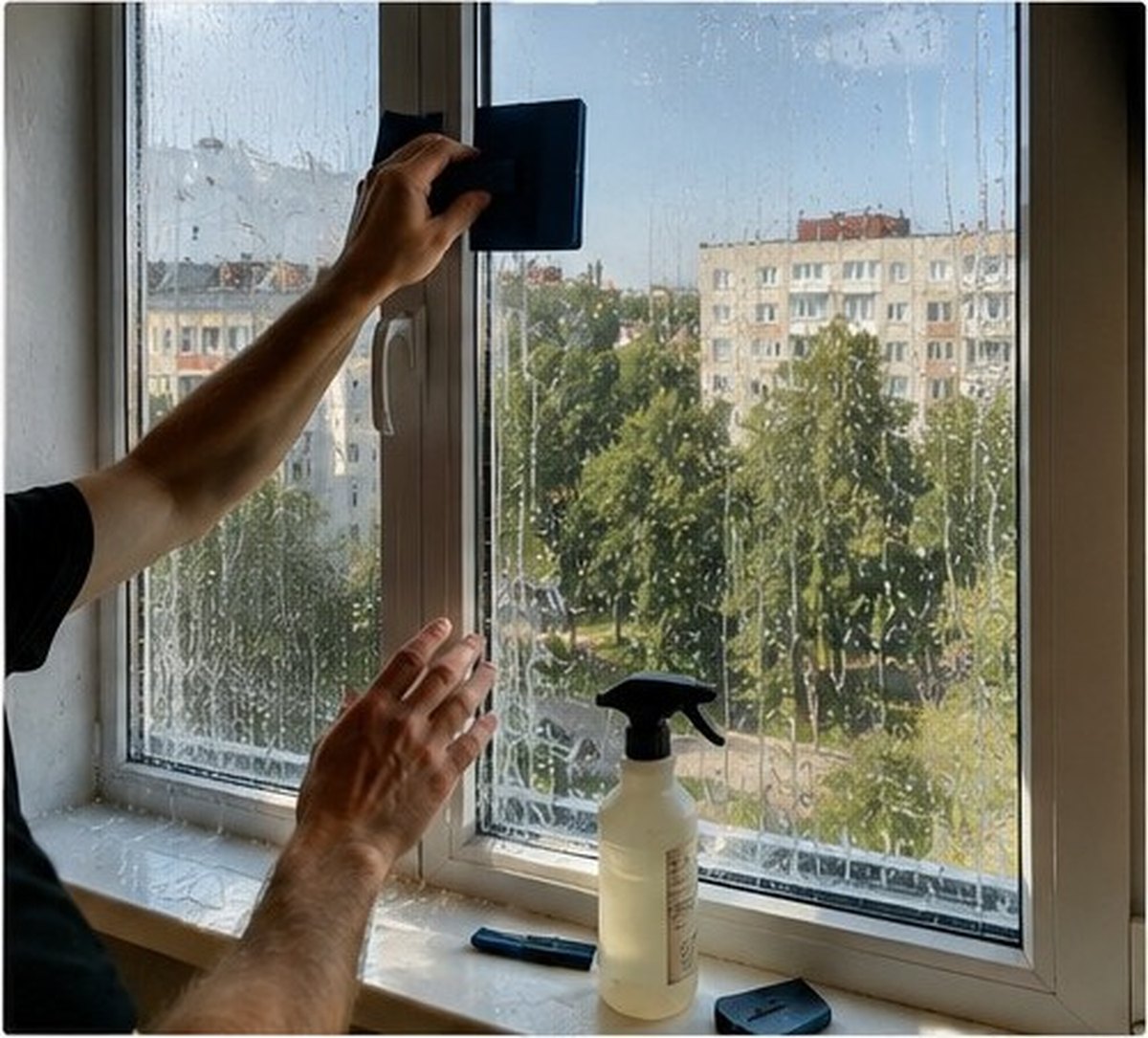
The main reason is that film solves a specific problem without touching the window itself. The alternatives - replacing the glazing unit, fitting blinds or hanging curtains - are either expensive and involve building work, or they block the light and the view.
Film works around the clock without anything having to be closed. Daylight and the view through the window stay exactly as they are; all that changes is what the glass lets in or out.
Films differ according to the job they do. Below are the five main families, with links to the pages where each is described in detail.
Reflect and absorb part of the sun's heat before it reaches the room. Designed for south- and west-facing windows, rooflights and glazed terraces that become unbearably hot in summer.
Solar control films and heat rejection films - from €25/m².
Look like sandblasted glass. They let daylight through but stop anyone seeing what is happening inside. Ideal for bathrooms, ground floors, consulting rooms and glass partitions.
Frosted films and opaque privacy films - from €25/m².
During the day they create a mirror effect from outside while reflecting away part of the sun's heat. In the evening, with the lights on indoors, the effect reverses - and that is worth knowing in advance.
Mirror films - from €25/m².
Thicker and tougher. If the glass is broken, the film holds the shards together so they do not fall into the room. Used on shopfronts, door glazing and large glass areas.
Safety films - from €25/m², reinforced from €35/m².
Patterns, motifs and banding for finishing glass, plus virtually clear films that block ultraviolet radiation and help protect furniture and stock from fading.
Decorative films from €29/m², UV films from €25/m².
A category of their own, working on heat in both directions: in summer they help reduce solar heat gain, and in winter they reflect part of the room's heat back inside.
Thermal insulation films - from €25/m².
Describe the problem you want to solve. We will call you, recommend the most suitable type of film and give you a quote.
You can buy adhesive film in a shop and fit it yourself. Sometimes that is perfectly sensible; sometimes it ends with the film having to come off again. Here is an honest look at both sides.
Dust under the film. This is the most common problem by far. Glass that looks clean is almost never clean enough. A speck of dust trapped beneath the film creates a small raised point that is clearly visible in daylight and can never be removed.
Air bubbles. These appear when the film is applied too dry or when the solution is not fully squeegeed out. Telling them apart from the normal patches of water that dry out by themselves is difficult without experience.
Edges lifting. If the film is cut exactly to the frame or slightly over it, the edge will start to lift in time.
Creases and tears. A large sheet handled without a second pair of hands and without the right tools easily sticks to itself, and at that point the material is ruined.
The main difference is in the preparation. We wash the glass several times over, scrape off anything stuck to it and clean the frame edges, which is where dust tends to fall from at the exact moment the film goes on. This stage takes longer than the application itself.
The second difference is the tools and the wet method: the solution allows the film to be nudged into precise position after it has been laid on, and only then is it squeegeed down. The third is experience with the material - how much of a gap to leave and how to work in summer heat, when the solution dries faster. You will find a full description of the process on our page about window film installation.
It would not be honest to claim you must never fit film yourself. There are situations where it is an entirely sensible solution, and we tell our clients so when that is the case.
If it is a single small piece of frosted film on a pantry or toilet window that nobody looks at closely, the result will most likely be good enough. There is little at risk and the material costs very little.
Adhesive film prices start from €25/m² for solar, frosted, mirror and UV films. Decorative films with a pattern start from €29/m², and reinforced safety films from €35/m². The price always includes both the material and the labour - there is nothing extra to pay for the installation.
Prices are excl. VAT and the minimum order is €75. You will find the full list on our prices page.
To begin with, a rough window count and a description of the problem is enough. We call you and outline an initial quote, then come out for free on-site measuring and confirm the price. For a typical apartment the work takes anything from a few hours to a full day.
We work throughout Riga and a 50 km radius, including Jūrmala, Mārupe, Ķekava, Salaspils, Ādaži and Ogre.
Adhesive film, or self-adhesive window film, is a thin layer of polymer material with an adhesive backing that is applied directly to glass already fitted in place. Its thickness is usually measured in hundredths of a millimetre, so it has no effect on how the window operates. Depending on the type, the film helps cut solar heat, provides privacy, blocks ultraviolet radiation, creates a decorative effect, or holds the shards of broken glass together.
Prices start from €25/m² for solar control, frosted, mirror and UV films. Decorative films with a pattern start from €29/m², and reinforced safety films from €35/m². The price includes both the film itself and the labour. Prices are shown excl. VAT and the minimum order is €75. We calculate the exact figure once we know the glass dimensions and how easy the windows are to reach.
It depends on the problem you want to solve. If the room overheats, you need solar control or heat rejection film. If people can see in from outside, you need frosted, opaque or mirror film. If furniture and stock are fading, you need UV film. If glass safety is the concern, you need safety film. If you are not sure, simply describe the situation in the form and we will recommend the most suitable option, along with an explanation of why.
You can, and in some cases it makes perfect sense - a single small piece of frosted film on a pantry or toilet window, for instance, where appearance hardly matters. On large glass areas, living rooms, offices and shopfronts, however, the result is rarely good without experience. The most common problems are dust trapped under the film, air bubbles, edges lifting and creases - and most of them cannot be put right afterwards.
The main reason is inadequate glass preparation. Glass that looks clean is almost never clean enough - a single speck of dust trapped underneath creates a raised point that is clearly visible in daylight. Air bubbles appear when the film is applied too dry or when the solution is not fully squeegeed out. Professional work means washing the glass several times over and using the wet method with a squeegee.
Yes - that is exactly how it normally works. We apply the film to glass that is already fitted, so there is no need to remove, dismantle or replace the windows. In most cases we work from inside the room, where the film is protected from the weather and lasts longer. This is precisely why film is far cheaper and far quicker than replacing a glazing unit or a whole window.
Describe your situation - we will call you, recommend the most suitable type and give you a quote. Free and with no obligation.
We have received your enquiry and will prepare a quote. We will call you on the phone number you provided.
